
Vincent van Gogh did not create his masterpieces with a single brushstroke. Each stroke added colour, depth and meaning. Some were barely noticeable on their own. Yet together, they created something extraordinary.
Building a better society is not very different. And building a greener one is perhaps even harder.
At Jijiwisha Society, our philosophy has always been simple: maximum happiness for the maximum number of people. Our work spans POSH training, awareness programmes, education, women's empowerment and environmental initiatives. But there is something that connects much of what we do. The surplus generated from our training programmes goes towards making our planet greener, one tree at a time.
It is a model that makes every training programme more meaningful. A corporate organisation investing in workplace safety is also contributing towards a greener tomorrow. An employee learning about dignity at work is, indirectly, helping create a healthier environment for someone else.
Yet, when we began discussing the redesign of Jijiwisha Society's website, we faced an interesting problem. How do you communicate all of this without making it look like just another NGO website?
Our Board Advisor, Suparna, who is also the Co-Founder of Ninth Atlas, took on the challenge of developing the concept and translating it into the website's design.
And what followed was an interesting journey of brainstorming, rethinking and occasionally discarding ideas that initially seemed promising.
The first thought was to create a unique character. Perhaps a character that could personify Jijiwisha, carry its message and make the organisation instantly recognisable. It was an interesting direction, but a character, however memorable, could not adequately represent the depth and interconnectedness of our work.
The next idea was to build the website around one large impact story. Rather than present different initiatives separately, we could tell a compelling narrative of transformation. But that too had a limitation. Jijiwisha's work is not one story. It is hundreds of small stories, often unfolding quietly, without dramatic beginnings or endings.
Then came the idea of making the website image-first. After all, photographs can communicate what paragraphs sometimes cannot. The faces of people we work with, the activities we conduct and the changes we try to bring about could become the primary language of the website.
This was closer. But it was still not quite right.
Photographs could show what we had done. They could not necessarily explain why one activity helped make another possible.
And that distinction mattered.
Because Jijiwisha is not simply an organisation conducting training programmes on one side and environmental activities on the other. The two are connected. The funding generated through training, after meeting the costs of those programmes, becomes a resource for plantation activities.
Every training programme therefore has the potential to create an impact that extends far beyond the people attending it.
Somewhere during this exploration, Suparna arrived at the idea that finally brought everything together.
What if an NGO were like a painter, and society its canvas?
A painter does not transform a blank canvas into a masterpiece in one sweeping movement. The process is painstaking. There are layers, corrections, experimentation and countless brushstrokes. Some strokes create the background. Others bring the picture to life.
Our work is much the same.
One training programme creates awareness. Another helps an organisation build a more respectful workplace. The surplus contributes to planting trees. Each tree must be counted, nurtured and given the opportunity to grow. No single effort transforms society, but every effort adds something to the larger picture.
It is almost like attempting a Van Gogh painting, one brushstroke at a time.
And suddenly, the website had found its central idea.
Instead of merely displaying Jijiwisha's activities, the website itself would become a canvas.
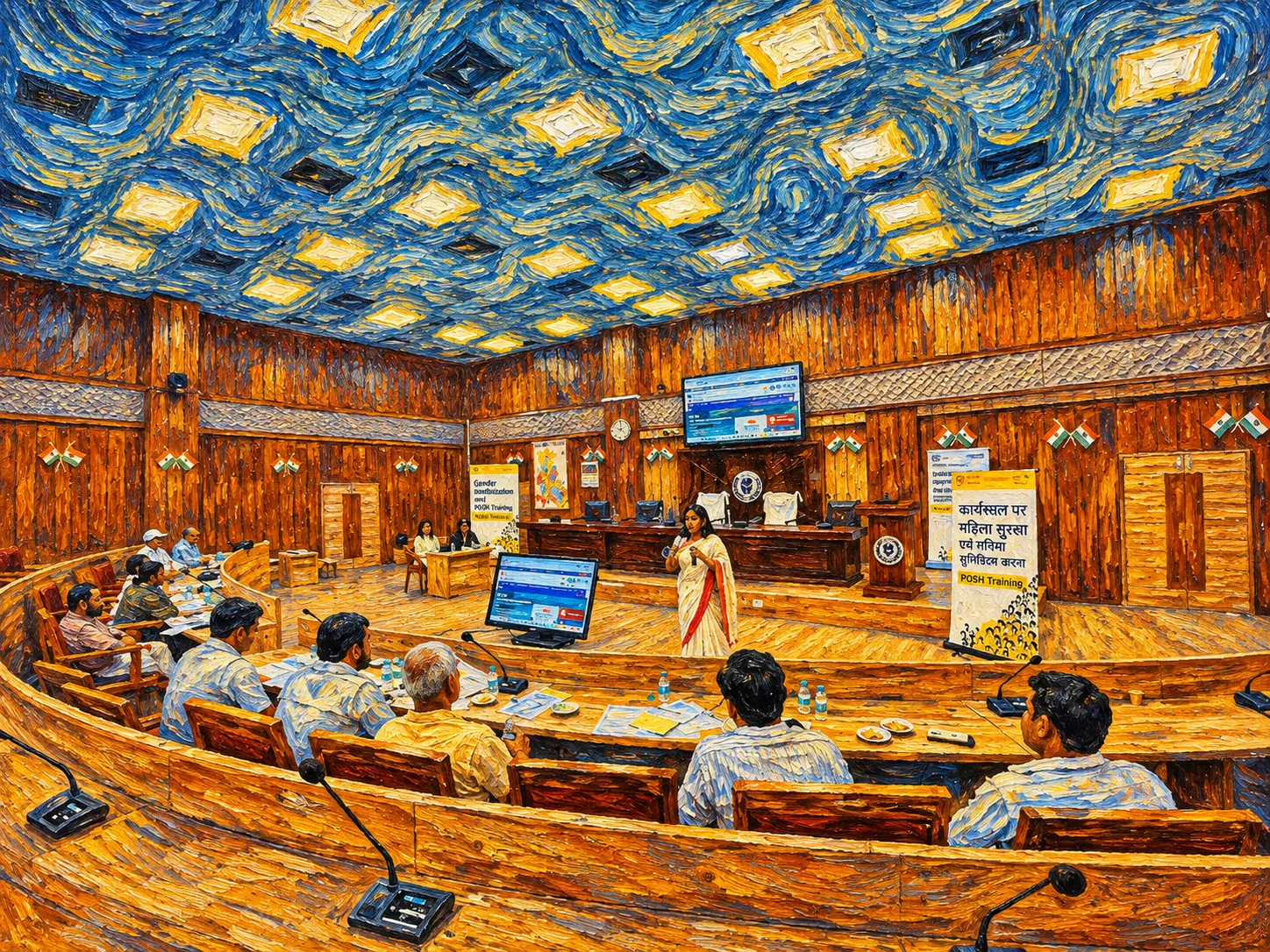
Our photographs would be presented as paintings. A brush would introduce the imagery. Colours would flow across sections. The green and blue of our identity would become part of the visual storytelling. Each programme would appear as another contribution to a larger, evolving picture.
The design would communicate something that words alone often struggle to explain: progress is cumulative, and seemingly small contributions can create something beautiful over time.
Suparna developed the entire creative concept and its interpretation into the website design. The task of bringing that vision to life through technology was undertaken by Himanshu Mishra, Founder of Ninth Atlas, who built the technical foundation of the new website.
And this was no ordinary technical assignment.
The idea required a website that behaved differently from a conventional collection of pages. The painting-inspired transitions, framed imagery, visual movement and interaction had to work together without compromising the practical purpose of the website.
After all, Jijiwisha's website is not meant to be a digital art exhibition. It must help organisations discover our training programmes, encourage individuals to volunteer, enable contributions and allow people seeking support to find the information they need.
Himanshu's technical implementation brought the creative direction into a functioning digital experience, where storytelling and usability could coexist.
For me, the most satisfying part of this exercise is not simply that Jijiwisha now has a distinctive website concept. It is that the design finally reflects the philosophy behind our work.
When an organisation approaches us for a POSH training programme, it is investing in a safer workplace. But when that programme generates a surplus which supports plantation, the organisation is also helping create something beyond its immediate business requirement.
One programme. Two dimensions of impact.
And when more organisations participate, more brushstrokes are added to the canvas.
Of course, creating a greener society is far more difficult than painting a beautiful picture. Trees require land, care, time and sustained commitment. The results are not always immediate. Sometimes, progress is measured not in impressive statistics, but simply in the number of trees planted and the number that continue to grow.
That is precisely why the metaphor feels so appropriate.
A masterpiece cannot be rushed. Neither can meaningful social change.
Looking back at the journey from a character-led concept to an impact narrative, then an image-first approach, and finally to a painter's canvas, I am reminded that good ideas rarely arrive fully formed. They emerge when people keep asking whether an idea truly represents what they are trying to communicate.
In this case, Suparna's conceptual thinking and design interpretation, combined with Himanshu's technical execution through Ninth Atlas, have given Jijiwisha a new way to tell its story.
More importantly, they have helped us express something we have believed in all along.
Every training programme can be more than a training programme. Every tree can be more than a tree. Every contribution is another brushstroke towards the society we hope to create.
And perhaps, one day, when we step back and look at everything we have collectively created, we will find that those thousands of seemingly insignificant brushstrokes have become something rather beautiful.
Until then, we will keep painting.
One programme. One tree. One brushstroke at a time.
Adv. Manjary Upadhyay
President, Jijiwisha Society